Open Source Humans — Edition 11
Everyone is building AI agents right now.
New tools appear every week. Copilots. Autonomous assistants. Multi-agent systems. The vocabulary of AI is expanding faster than most of us can properly evaluate it.
This article breaks down the science, art, and architecture of Agent #001 the conversational interface behind my project: 3MistakesOfMyLife.in
Let’s begin with a word that is often used casually but rarely examined carefully.
Science.
Science is the disciplined process of observing reality, identifying patterns, forming hypotheses, testing them through interaction with the world, and refining our understanding based on evidence.
In simple terms:
Science is a structured method for interacting with reality.
We are entering an era where artificial intelligence is beginning to participate in that interaction with reality.
AI agents are not just pieces of software.
They are systems designed to interact with humans through one of the most fundamental human mechanisms:
CONVERSATION.
But conversation itself is not a casual activity.
It is a highly structured phenomenon.
Here is how I define it:
A Conversation Is A Very Scientific Event Involving Many Forces Of Nature To Yield Maximum Benefits For All The Involved Parties, Depending Upon The Match In Frequencies, Intents AND Uncovered ASSUMPTIONS. 🤓
Every conversation contains invisible forces:
• intentions • attention • language • emotional states • assumptions • mental models of reality • & many many more
When these forces align, conversations create clarity and progress.
When they do not align, conversations produce confusion, misunderstanding, and wasted effort.
AI agents now operate inside this field of human interaction.
They do not simply generate text.
They participate in conversations that shape how people understand systems, decisions, and ideas.
And this leads to a deeper observation.
Most of humanity is not disciplined.
Most people also do not understand even an ounce of self-awareness.
Without discipline and self-awareness, conversations become reactive instead of constructive.
Assumptions remain hidden.
Intentions remain unclear.
And decisions become inconsistent.
In a world increasingly shaped by intelligent systems, this gap becomes even more important.
A Note From the Beginning of My Journey
About a year ago, a mentor told me something that stayed with me.
There are a lot of Agentforce agents being deployed right now and many of them are failing.
Not because the technology is weak.
But because the architecture behind them is weak.
He told me something more.
The industry is going to need a lot of critical thinkers who can design these systems properly.
So I started learning the ABCs of Agentforce.
I’m a slow learner but I’m persistent and hungry.
Over the past months I have been studying, experimenting, and building.
Today I have my first agent running.
Is it impressive?
Not really.
It is barely up to the mark compared to the best ones out there.
And that’s perfectly fine.
I am not a specialist yet.
But I am working on it.
My constraints are very real.
I get about 4 hours a day to focus on this work.
But I also understand something deeply:
There has never been a better time to build.
Artificial intelligence gives us the ability to design systems that operate at humanity scale.
Which leads to a question I have been asking myself:
What would you like to leave this world with?
My answer is this project.
A Grounding Note About the Project
The project behind the agent I am building is called 3 Mistakes of My Life, It lives on: 3MistakesOfMyLife.in
This project is a discipline program for kids, being built in collaboration with parents & is closest to my heart, being a parent myself. The premise is simple. If the next generation is going to grow up in a world shaped by artificial intelligence, they will need stronger foundations in discipline, reflection, self-awareness, structured thinking.
These qualities are not developed through lectures. They are developed through guided conversations and deliberate practice. The system introduces a structure where: Parents participate alongside their kids. Mentors guide the parents. And discipline becomes a measurable practice rather than a vague concept.
The agent I am building is Agent #001, is the first conversational interface to this system.
Current Architecture — Agent #001
Let’s start with reality. Agent #001 is extremely basic.
It currently performs one primary function: It explains the project. That’s it.
There is:
- no persuasion layer
- no onboarding automation
- no behavioral coaching
- no lifecycle engagement
The agent simply introduces the project and answers questions using a structured knowledge library. The system currently operates through a small set of conversational topics.
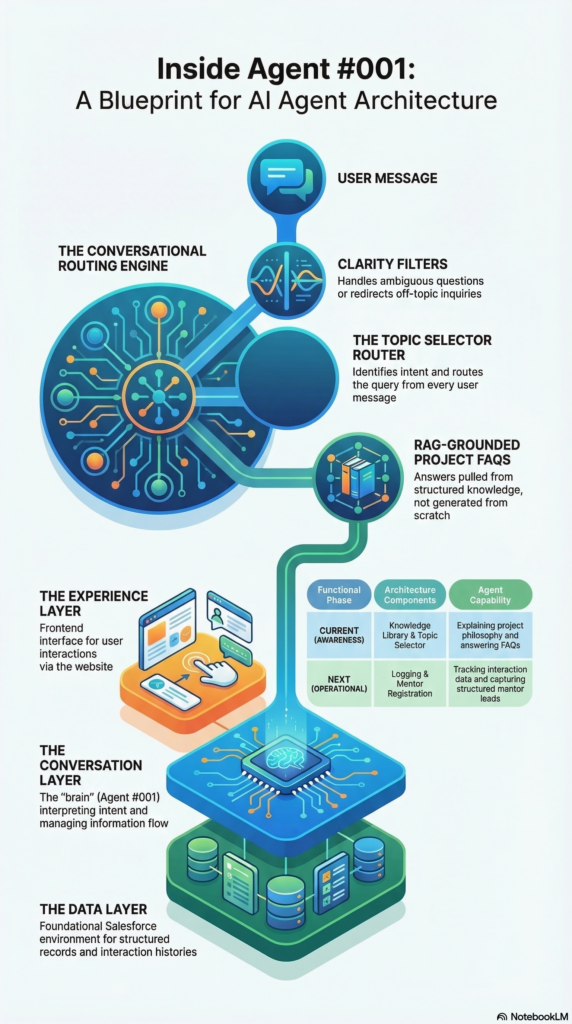
Topic Selector
Every user message first passes through Topic Selector. Its job is simple: Understand the user’s intent and route the conversation to the correct topic. Think of it as the conversation router.
Project FAQs
If a user asks about the discipline program or the project itself, the agent activates Project FAQs. This topic retrieves information from the knowledge library using retrieval-augmented generation (RAG). Instead of generating answers blindly, the agent references documentation stored from: 3MistakesOfMyLife.in This keeps responses grounded in the actual project.
Off Topic
If a question falls outside the scope of the project, the agent gently redirects the user.
Example:
“I’m here to help with the discipline program. Would you like to know how it works?”
This protects the boundaries of the system.
Architectural Principle
While building Agent #001, one design principle became clear.
Agents should sit between experience and data, not replace either.
In this system:
Experience happens through the website:
The agent acts as a conversation layer.
And structured records eventually live inside a Salesforce data layer.
Keeping these layers separate allows the system to evolve without breaking the conversation interface.
What Is Missing
Right now the agent supports only one stage of the system: Awareness.
Everything else still needs to be built.
Missing layers include:
• parent onboarding • mentor registration • mentor-family matching • discipline session logging • behavioral progress tracking • referral loops • payment systems
The business architecture exists conceptually, but the operational layers are still under construction.
Data Before Intelligence
One thing has already become clear to me.
AI agents do not fail because of prompts.
They fail because the underlying data architecture is messy.
Most CRM environments struggle with:
• inconsistent objects • incomplete fields • fragmented interaction histories
When an agent is introduced into that environment, it simply amplifies the chaos.
So before expanding the intelligence of the agent, the system must first define:
• clean data structures • traceable interaction records • clear ownership of information
Only then can the agent become truly useful.
Where Salesforce Comes In
This project is being developed inside the ecosystem of my organization:
Unfinished Innovations LLP
Our digital presence currently includes:
nothingelsematterz.com and 3MistakesOfMyLife.in
which act as a playground for experimentation and learning.
As the system evolves, Salesforce will support the structured data layer behind the project.
The Next Iteration
The next iteration of Agent #001 focuses on two capabilities.
- Conversation Logging Currently, conversations with the agent are not stored anywhere. The next step is to log interactions so we can understand: • what questions users ask • where conversations break • how the agent improves over time
- Mentor Registration The second capability is mentor registration inside the conversation itself. If someone expresses interest in mentoring parents, the agent will collect:
- • name • email • location • background
This will create the first structured dataset for the mentor ecosystem.
The $1M Constraint
At the beginning of this year I committed to a constraint.
Generate $1,000,000 in measurable value by December 31, 2026.
That does not necessarily mean this discipline project itself will generate that revenue.
Instead, this journey is training me to architect systems that help Salesforce clients generate measurable outcomes through agent implementations.
Every artifact I build here is part of that learning process.
A Note to System Integrators
The architectural questions I am exploring in this project appear inside almost every Salesforce implementation today.
- How do we structure data so agents can reason correctly?
- How do we design conversational systems that actually support business workflows?
- How do we move from experimentation to measurable outcomes?
If you are a Salesforce system integrator exploring Agentforce, I would genuinely love to learn how you are approaching these problems.
I am building this system in public.
And I will keep documenting the architecture as it evolves.
Agent #001 is just getting started.
One Response